
Academy Reference: Comprehensive Glossary, Probability Tables, and Rules Summary
An authoritative quick-reference handbook containing the comprehensive glossary of standard backgammon terms, essential probability and dice combination tables, tournament procedure rules, and a fully annotated illustrative opening sequence.
Interactive Position & Tactical Setup
Standard Starting Layout
The 15-Checker Setup (167 Pips Each)
Strategic Insight & Key Lesson
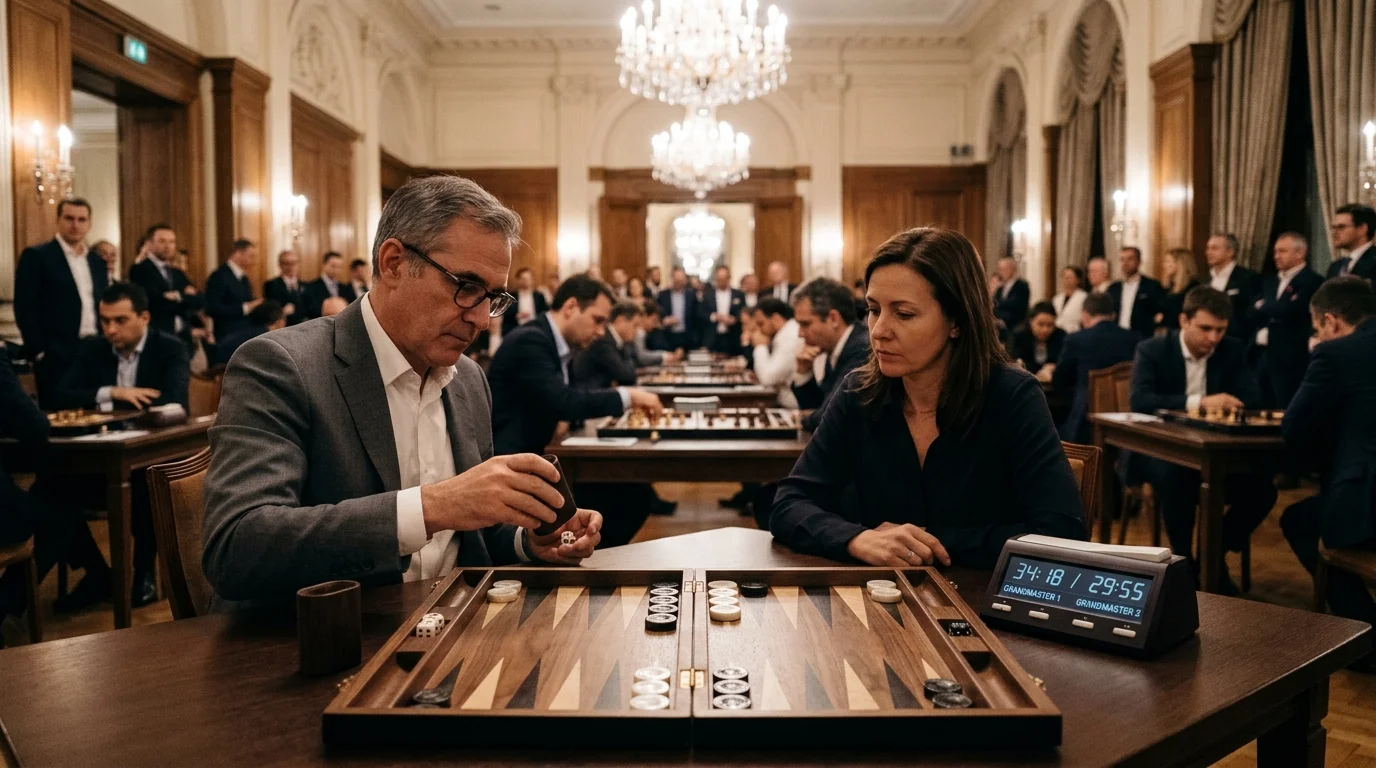
The standard opening backgammon layout with all 30 checkers in position. Both players begin with exactly 167 pips.
Key Strategic Takeaways
- Master standard tournament vocabulary to analyze games and communicate moves using algebraic notation.
- Internalize the key probability numbers: direct shots (1–6 pips away) carry between 11/36 and 17/36 hitting chances.
- A 6-prime is completely impassable, while partial primes (4-prime, 5-prime) obstruct checkers by eliminating specific leaping numbers.
- The Take-Point is dynamic: 25.0% is a benchmark under dead-cube money assumptions, but shifts under live cube and gammon risks.
- Under the Jacoby Rule (money play only), gammons count only if the cube has been turned and accepted.
Authoritative Backgammon Terminology & Concepts
Use this quick-lookup glossary during your study to clarify tactical and strategic terms:
| Term | Classification | Definition & Strategic Context |
|---|---|---|
| Anchor | Strategy | A secure point (2+ checkers) established inside the opponent’s home board (points 20–24 in P1 coordinates). |
| Backgame | Strategy | A high-risk defensive strategy holding two or more anchors in the opponent’s home board with substantial timing deficit, aiming to hit a late shot as the opponent clears high points. |
| Bar-Point | Geography | The 7-point (or opponent’s 18-point), situated directly adjacent to the center bar in the outer board. |
| Blot | Rules | A single checker sitting alone on a point, vulnerable to being hit and sent to the bar by an opposing checker. |
| Boxcars | Slang | Rolling double sixes (6-6), the highest numerical roll in backgammon (24 total pips). |
| Builder | Tactical | A spare checker positioned in the outer board or high inner board ready to help construct a key point on upcoming turns. |
| Candidate Play | Evaluation | One of several viable candidate moves considered by a player before committing to an action. |
| Crawford Rule | Match Play | The rule prohibiting doubling cube usage for the single game immediately following a player reaching 1-away in match play. |
| Crunch | Strategy | When lack of timing forces a player to destroy their own made points, burying checkers deep on low points. |
| Dead Cube | Cube Play | A cube level that provides sufficient points for either player to win the match, eliminating constructive redoubling. |
| Direct Shot | Tactical | A vulnerable blot located within 1 to 6 pips of an opposing checker, hitable with a single die number. |
| Effective Pip Count (EPC) | Racing | The raw pip count plus an adjustment for wastage, reflecting the true number of rolls needed to bear off. |
| Free Drop | Match Play | A leader’s tactical option at 1-away to decline an initial double from a trailer at an odd-away score without conceding match parity. |
| Gammon | Rules | Winning a game before the opponent has borne off a single checker, worth twice the base stake or match points. |
| Golden Point | Strategy | The 5-point in your own board (or the 20-point in the opponent’s board), the most tactically valuable point on the board. |
| Holding Game | Strategy | A defense where a player trails in the race but holds an advanced anchor (e.g. 20-point) to threaten late shots. |
| Indirect Shot | Tactical | A blot 7 or more pips away that requires a combination of both dice or doubles to be hit. |
| Jacoby Rule | Money Play | Money-play rule stating that gammons count only if the doubling cube has been offered and accepted. |
| Lover’s Leap | Openings | The opening roll of 6-5 played 24/13, leaping a back runner directly to the midpoint. |
| Market Loser | Cube Play | A roll on your upcoming turn that improves your position so decisively that the opponent would correctly drop a double next turn. |
| Performance Rating (PR) | Evaluation | The average equity lost per decision measured across unforced moves; lower PR indicates superior tactical consistency. |
| Prime | Strategy | A continuous row of made points (4, 5, or 6 points long) that restricts opposing movement; a full 6-prime is completely impassable. |
| Pure Play | Strategy | Playing boldly and constructively to build points rather than making timid, passive safe moves. |
| Recube / Redouble | Cube Play | Doubling the stakes a subsequent time by the player who currently owns the doubling cube. |
| Slot | Tactical | Deliberately placing a single blot on a key point (such as the 5-point) with the intention of covering it next roll. |
| Split | Tactical | Separating the two back runners on point 24 (e.g. 24/23 or 24/20) to prepare an advanced anchor. |
| Take-Point | Mathematics | The break-even win probability required to accept a double (25.0% under dead-cube, money-play, zero-gammon assumptions; dynamic in live match play). |
| Tempo Hit | Tactical | A hit made to strip the opponent of half their next roll, preventing them from making an aggressive attacking play. |
| Too Good to Double | Cube Play | A dominant position with substantial gammon chances where playing on without doubling offers higher expected value, despite the risk of positional deterioration. |
| Wastage | Racing | The extra pips lost when high numbers on the dice bear off checkers from low home-board points. |
Master Probability Reference Tables
Use these mathematical probability tables as an exact reference during study and position analysis:
| Closed Points | Open Points | Entering Combinations / 36 | Entering Success Rate (%) | Dancing Failure Rate (%) |
|---|---|---|---|---|
| 0 points | 6 open | 36 / 36 | 100.0% | 0.0% |
| 1 point | 5 open | 35 / 36 | 97.2% | 2.8% |
| 2 points | 4 open | 32 / 36 | 88.9% | 11.1% |
| 3 points | 3 open | 27 / 36 | 75.0% | 25.0% |
| 4 points | 2 open | 20 / 36 | 55.6% | 44.4% |
| 5 points | 1 open | 11 / 36 | 30.6% | 69.4% |
| 6 points | 0 open (Closed) | 0 / 36 | 0.0% | 100.0% |
Annotated Opening Sequence: An Illustrative Tactical Breakdown
To illustrate how coordinate tracking, point-building, and movement direction interact in early play, consider this four-turn opening sequence tracked under Player 1’s coordinate system (Points 1–24 from Player 1’s perspective: Player 1 travels 24 → 1; Player 2 travels 1 → 24):
Initial State: Both players begin with 15 checkers and 167 pips. Player 1: 24:2, 13:5, 8:3, 6:5. Player 2: 1:2, 12:5, 17:3, 19:5.
• Turn 1 (Player 1 rolls 3-1): Action: 8/5, 6/5. Player 1 moves 8 to 5 (3 pips) and 6 to 5 (1 pip), establishing the 5-point (Golden Point) with two checkers. Player 1 pip count drops from 167 to 163. Player 2 remains at 167 pips (Player 1 leads by 4 pips).
• Turn 2 (Player 2 rolls 6-4): Player 2 travels from point 1 toward point 24. Point 5 is blocked by Player 1’s made point, so Player 2 cannot play 1/5. Action: Player 2 leaps a back runner with 1/7/11 (moving 6 pips from 1 to 7, then 4 pips from 7 to 11, both open points). P2 checkers are now 1:1, 11:1, 12:5, 17:3, 19:5. Player 2 pip count drops by 10 from 167 to 157 pips (Player 2 leads the race by 6 pips).
• Turn 3 (Player 1 rolls 6-1): Action: 13/7, 8/7. Player 1 moves 13 to 7 (6 pips) and 8 to 7 (1 pip), securing the 7-point (Bar-point). Player 1 now controls points 5, 6, 7, and 8. Player 1 pip count drops by 7 from 163 to 156 pips (Player 1 leads by 1 pip).
• Turn 4 (Player 2 rolls 5-2): Action: 11/16, 12/14. Player 2 advances the outer blot from 11 to 16 with the 5, and brings down a builder from the midpoint (12 to 14) with the 2. Player 2 pip count drops by 7 from 157 to 150 pips (Player 2 leads by 6 pips).
Positional Summary: This opening exchange illustrates the fundamental clash of strategic plans: Player 1 has prioritized home-board and bar-point structure, while Player 2 has prioritized runner mobility and racing advancement.
Tactical Check: Test Your Comprehension
Select candidate plays and verify your tactical reasoning against engine rollout analysis.